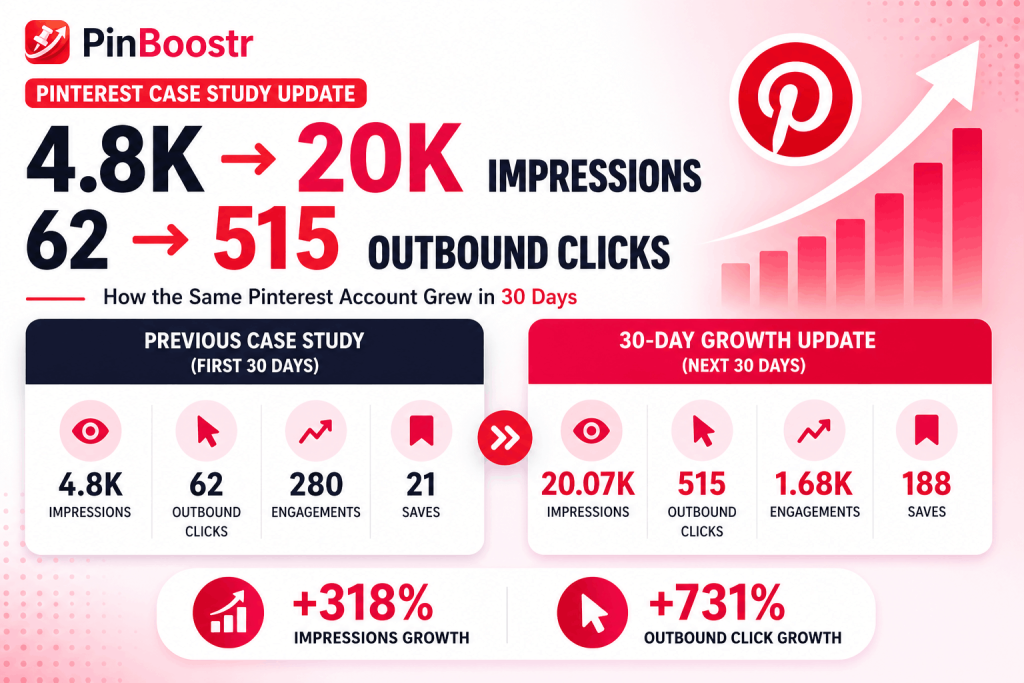
This is a follow-up. In my first case study, a brand-new Pinterest account reached 4.8K impressions and 62 outbound clicks in 30 days using a manual, keyword-focused workflow. This time I handed the same workflow to PinBoostr’s Growth Brain autopilot and let it run. Thirty days later: 20.07K impressions, 1.68K engagements, 515 outbound clicks, and 188 saves. Here is the side-by-side, what autopilot actually changed, and why outbound clicks are still the only number I really trust.
A few weeks ago, I published a case study about a brand-new Pinterest account.
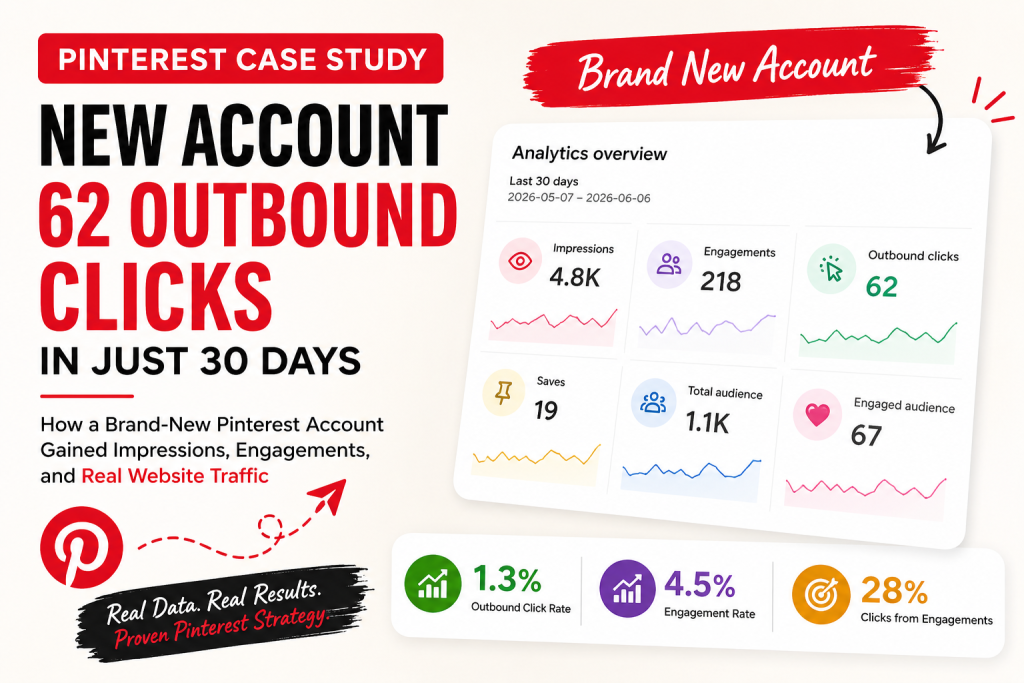
The story was simple. I took an account with no history, ran a structured Pinterest SEO workflow by hand, and after 30 days it had reached 4.8K impressions, 218 engagements, 62 outbound clicks, and 19 saves.
The headline lesson back then was not the impressions. It was the 62 outbound clicks. Clicks meant the pins were attracting the right people, not just being seen.
That test left one obvious question hanging.
The workflow worked. But it took real time. Keyword research, pin titles, descriptions, fresh variations, board matching, scheduling, and then checking the numbers. Doing all of that by hand is fine for one account. It does not scale.
So I asked a different question this round.
What happens if I stop doing the workflow manually and let it run on autopilot instead?
That is exactly what Growth Brain is built for. So I turned it on, connected the account, and mostly got out of the way for 30 days.
The 30-Day Results, Round Two
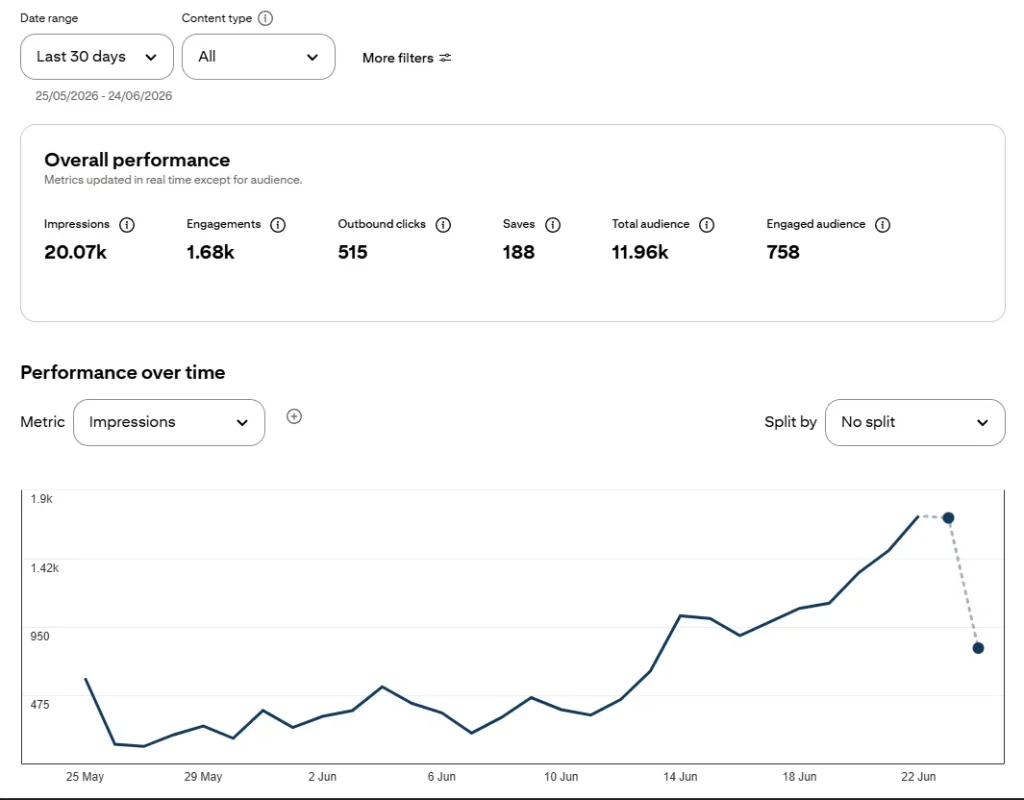
Here are the numbers from the last 30 days, pulled straight from Pinterest analytics:
- Impressions: 20.07K
- Engagements: 1.68K
- Outbound clicks: 515
- Saves: 188
- Total audience: 11.96K
- Engaged audience: 758
That works out to roughly:
- A 2.6% outbound click rate
- An 8.4% engagement rate
- Around 31% of engagements turning into outbound clicks
- A 0.9% save rate
I want to be honest about what these are and what they are not.
This is still one account. It is still a single 30-day window. It is not proof of anything universal, and your niche, images, and links will all change the outcome.
But compared to the manual test, the jump is hard to ignore.
The Side-by-Side Comparison
This is the part I found most interesting, so I lined the two tests up directly.
| Metric | First test (manual workflow) | This test (Growth Brain autopilot) | Change |
|---|---|---|---|
| Impressions | 4.8K | 20.07K | ~4.2x |
| Engagements | 218 | 1.68K | ~7.7x |
| Outbound clicks | 62 | 515 | ~8.3x |
| Saves | 19 | 188 | ~10x |
| Total audience | 1.1K | 11.96K | ~11x |
A few things stand out.
Impressions grew about 4.2x. That is solid, but impressions were never the point.
Outbound clicks grew about 8.3x. That is the number I care about, and it grew almost twice as fast as impressions did.
That gap matters. It means the account did not just get shown more. The clicks scaled faster than the views, which is the opposite of what usually happens when an account simply gets louder.
In other words, the quality of the reach went up, not just the volume.
Why Outbound Clicks Still Matter Most
I said it in the first case study and I will say it again here, because it is the whole reason I run these tests.
Impressions tell you your pins were shown. Outbound clicks tell you someone left Pinterest to visit your site.
One is exposure. The other is traffic.
A pin can rack up impressions and send almost nobody anywhere. That usually means the image earned attention but the title gave no reason to click, or the pin did not match what the searcher actually wanted.
So I do not get excited about 20K impressions on their own.
I get interested when the outbound click rate climbs at the same time. This round it nearly doubled, from 1.3% to about 2.6%. For every 100 impressions, roughly 2.6 people now leave for the website instead of 1.3.
Double the click rate on more than four times the impressions is where the compounding happens.
If you use Pinterest for a blog, an affiliate site, an ecommerce store, a SaaS, or digital products, this is the metric that pays the bills. Saves are nice. Engagements are useful. Clicks are revenue potential.
What Growth Brain Autopilot Actually Did
I want to be clear about something, the same way I was last time.
Autopilot did not invent a new strategy. It ran the same workflow I described in the first case study, just without me babysitting every step.
Here is what that looked like in practice:
It kept the keyword focus consistent. The pins stayed anchored to topics with real search intent instead of drifting into random posting.
It generated fresh pin variations on a schedule. Different titles, different angles, different hooks pointing to the same URLs, which is exactly the kind of testing I struggle to keep up with by hand.
It matched pins to relevant boards instead of dumping everything into one place.
It kept the cadence steady. No three-pin bursts followed by a quiet week. Pinterest rewards consistency, and a machine is simply better at being consistent than I am.
And it kept feeding on the performance data, leaning into what was already working.
That last part is the real unlock.
Manually, I check analytics maybe twice a week and adjust slowly. Autopilot can notice which angles are earning clicks and produce more of that style without waiting for me to get around to it.
That is not magic. It is just the same good habits, done more often and more evenly.
Reading the Growth Curve
The impressions chart tells the story better than any single number.
The first week sat low and a little choppy. Late May hovered in the low hundreds per day with the usual new-account noise. Nothing dramatic, which is normal.
Early June stayed bumpy. Some days climbed, some dipped, and if you only looked at a three-day window you might have called it flat.
Then around the middle of June, the line changed character. From roughly the 14th onward it climbed steadily, and by around the 22nd it was pushing near 1.9K impressions in a single day.
One honest note. The very last point on the chart drops sharply on a dashed line. That is not a crash. Pinterest shows the most recent day as incomplete because the data is still settling, so I would ignore that final tail completely. The real trend is the climb, not the dotted drop at the end.
The shape is the lesson. Pinterest growth is rarely a straight line. It is slow, noisy, and then it starts compounding once the account has enough signal to work with.
What Worked This Round
The biggest win was consistency at volume without losing intent.
In the manual test, I had to choose between posting often and posting carefully. Autopilot mostly removed that tradeoff. The pins kept coming, and they kept matching real search topics.
Fresh variations did a lot of heavy lifting. Pointing several different angles at the same URL meant more chances to match a searcher, and the click rate suggests some of those angles landed well.
Board relevance held up. Because pins went to topical boards instead of a catch-all, Pinterest had cleaner signals about what each pin was for.
And steady cadence clearly helped the compounding. The mid-June climb did not come from one viral pin. It came from a stack of consistent days building on each other.
What I Would Still Be Careful About
I am not going to pretend this is a finished story.
This is one account in one niche over 30 days. A different niche with weaker images or vaguer links could easily produce a flatter curve.
Autopilot also still depends on the inputs. If the underlying topics have no search demand, or the linked pages do not deliver, no amount of consistency will fix that. Automation amplifies a good strategy. It does not rescue a bad one.
And I would not read the late-June peak as a permanent new baseline. Single days spike. What I trust is the 30-day shape and the click rate, not any one tall bar.
So I am treating this as a strong second data point, not a guarantee.
What I Am Testing Next
The plan from here is the same discipline I used last time: track 30, 60, and 90 days, and improve based on the data.
First, I want to find the pins with the highest outbound click rate and let autopilot produce more variations around those specific angles.
Second, I want to watch whether the click rate holds above 2% as impressions keep growing, or whether it settles back down. That tells me if the quality is durable.
Third, I want to see how the engaged audience number develops. Right now 758 of the 11.96K total audience counts as engaged. Growing that engaged slice usually signals the account is reaching the right people, not just more people.
Fourth, I will keep doing the boring thing: tracking outbound clicks, not vanity metrics.
How This Fits PinBoostr
This test is a big reason PinBoostr exists in the shape it does.
A scheduler alone would not have produced this. Scheduling is one step in a longer loop. The results came from the whole workflow running together: keyword focus, pin creation, SEO titles and descriptions, fresh variations, board matching, scheduling, and learning from the numbers.
Growth Brain is the autopilot layer that runs that loop so you do not have to hold all of it in your head.
The goal was never automation for the sake of posting more pins. The goal is automation that helps you create better pins, more consistently, and then doubles down on what earns clicks.
That is the difference between being busy on Pinterest and actually building a traffic channel.
Frequently Asked Questions
Did Growth Brain autopilot really 8x the outbound clicks on its own? The clicks grew from 62 to 515 across the two 30-day tests, which is roughly 8.3x. Autopilot did not invent a new strategy. It ran the same keyword-focused workflow far more consistently than I did by hand, and consistency at volume is what compounded.
Is this the same workflow as the first case study? Yes. The strategy is identical: search-intent topics, keyword pin titles, clear descriptions, fresh variations, relevant boards, and tracking outbound clicks. The only change was letting autopilot run it instead of doing every step manually.
Why focus on outbound clicks instead of impressions? Impressions only mean a pin was shown. Outbound clicks mean someone left Pinterest to visit your site. If you use Pinterest for traffic, sales, or leads, clicks are the metric that actually matters, and this round the click rate nearly doubled to about 2.6%.
What does the dashed drop at the end of the chart mean? That is incomplete data for the most recent day, which Pinterest always shows as a dotted line. It is not a real decline. The meaningful trend is the steady climb through mid and late June.
Will I get the same results? Maybe not. This is one account, one niche, one 30-day window. Your images, topics, and linked pages all change the outcome. Autopilot amplifies a sound strategy, but it cannot rescue weak inputs.
Final Thoughts
The first case study proved the workflow worked. This one tested whether it could run without me.
It could, and the numbers stepped up across the board: about 4.2x the impressions, 8.3x the outbound clicks, and an outbound click rate that nearly doubled.
But the takeaway is not “automation wins.” It is more specific than that.
A good Pinterest strategy, run consistently and pointed at the right searchers, compounds. Most people cannot keep that consistency by hand for 30 straight days. Autopilot can.
So the lesson is the same one I started with, just proven a little harder.
Do not chase impressions. Chase clicks.
Post with intent, create fresh variations, match the right boards, and track outbound clicks. Then let consistency do the slow, compounding work.
That is how a Pinterest account stops being a place to post images and starts being a traffic engine.